
Credit Score vs. Credit History: Which Tells You More About a Rental Applicant?
 Lauren Walton·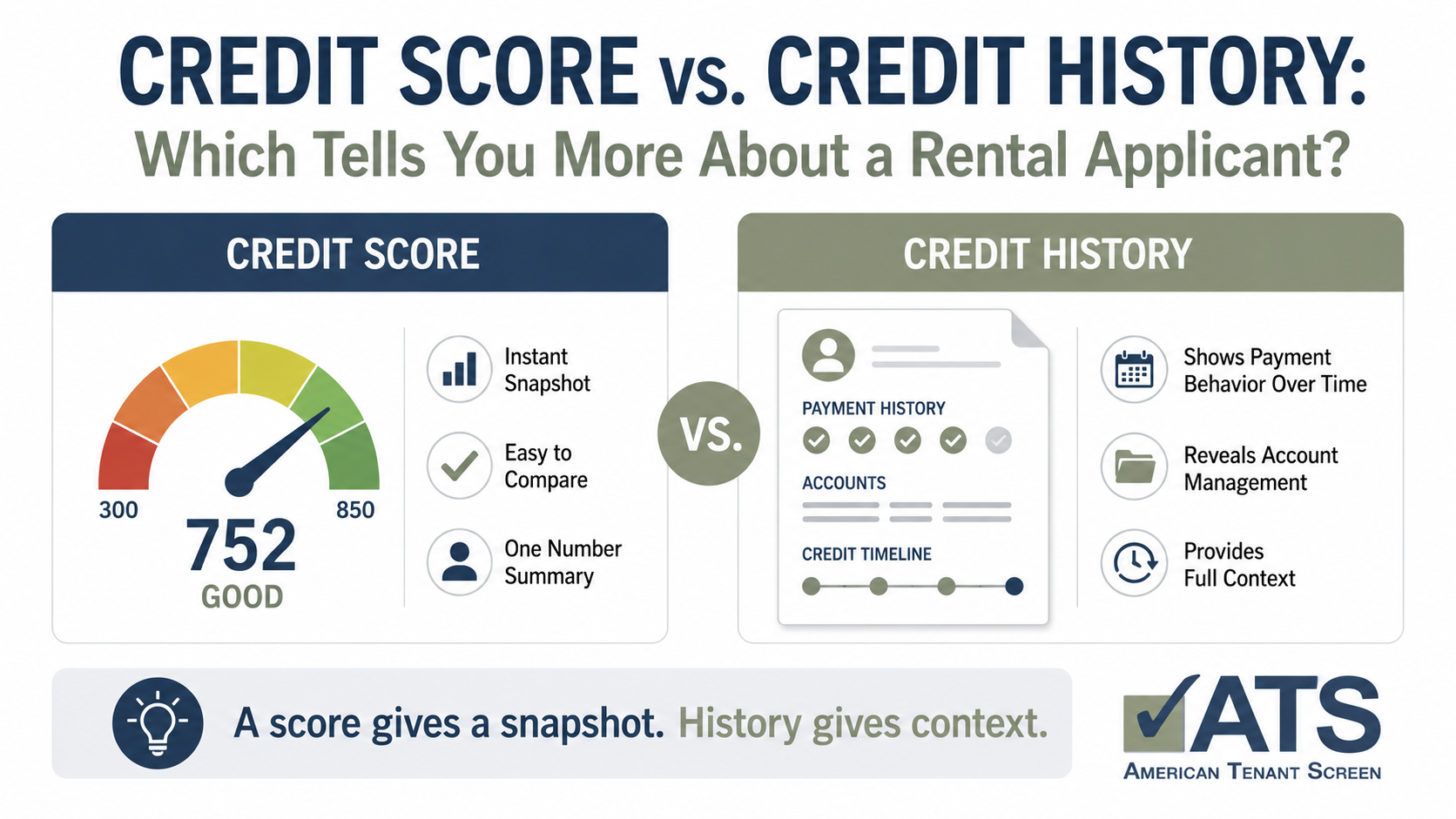
For many property managers, a credit score is one of the first numbers they look at when reviewing a rental applicant.
It is simple.
It is familiar.
And it is easy to compare against written qualification criteria.
But a credit score is only a summary.
The applicant's credit history can often provide much more context about how that score was created.
So which is more useful when evaluating a rental applicant?
The answer is usually:
Both—but they tell you different things.
What Is a Credit Score?
A credit score is a numerical representation of information contained in a consumer's credit file.
Different scoring models may calculate scores differently, but scores generally reflect factors such as:
- Payment history
- Amount of debt
- Credit utilization
- Length of credit history
- Types of accounts
- Recent credit activity
The advantage of a credit score is simplicity.
A property manager can quickly compare applicants against established written criteria.
For example, a housing provider may establish a minimum credit standard as part of its screening policy.
But the score itself does not explain every detail behind the number.
What Is Credit History?
Credit history is the underlying information contained in the credit report.
Depending on the report, it may show:
- Open accounts
- Closed accounts
- Payment history
- Late payments
- Collections
- Outstanding balances
- Credit limits
- Bankruptcies
- Account ages
Instead of giving you one number, credit history provides a broader picture of the applicant's credit behavior.
That context can sometimes be more informative than the score alone.
Two Applicants Can Have the Same Score for Very Different Reasons
Imagine two applicants both have a credit score of 650.
At first glance, they may appear identical.
But their credit reports could tell very different stories.
Applicant A
Applicant A has:
- Several years of established credit
- Mostly on-time payments
- One recent medical collection
- Moderate credit card utilization
Applicant B
Applicant B has:
- Multiple recent late payments
- Several maxed-out credit cards
- Two accounts in collections
- A short credit history
The scores may be similar.
The underlying histories are not.
That is why relying only on a credit score may leave important information unexplored.
A Lower Score Doesn't Always Mean the Same Thing
Credit scores can be affected by many different circumstances.
Someone may have a lower score because of:
- A limited credit history
- High credit utilization
- Recent medical debt
- A past period of financial difficulty
- Late payments
- Collections
- A recent major life event
Different situations may have different relevance to a housing provider's established criteria.
The important point is to avoid treating the score as if it tells the entire story.
A High Score Doesn't Tell You Everything Either
The same principle works in reverse.
A strong credit score does not automatically mean an applicant is a perfect rental candidate.
For example, an applicant could have excellent credit but still:
- Have limited rental history
- Provide unverifiable income
- Submit inconsistent application information
- Fail to meet other established qualification criteria
Credit is one part of a broader screening process.
It should not necessarily be treated as a substitute for identity, income, rental history, or other applicable screening factors.
Why Property Managers Like Credit Scores
There are good reasons credit scores are widely used.
They are:
- Easy to understand
- Fast to review
- Standardized
- Useful for creating objective criteria
- Familiar to leasing staff
A score can be helpful as one component of a consistent screening policy.
The key is understanding its limitations.
Why Credit History Adds Context
Credit history can help answer questions that a score cannot.
For example:
- Are late payments recent or several years old?
- Is the applicant carrying unusually high debt?
- Are collections isolated or repeated?
- Is the credit file established or very new?
- Has the applicant demonstrated improvement over time?
Again, the goal is not to create subjective exceptions for every applicant.
It is to understand what information is actually contained in the report and how that information relates to your written criteria.
What About Applicants With Little or No Credit?
Not every qualified renter has an extensive credit history.
Some applicants may have limited credit because they are:
- New to the workforce
- Young adults
- Recent immigrants
- Recently divorced
- People who primarily use cash or debit
- Consumers who intentionally avoid borrowing
A thin credit file is different from a history of unpaid obligations.
Housing providers should decide in advance how limited credit will be handled and incorporate that approach into their written screening standards.
That helps keep decisions consistent.
Credit Should Not Be Viewed in Isolation
A strong tenant screening process looks at the application as a whole.
Depending on your screening policy, that may include:
- Identity verification
- Income verification
- Credit information
- Rental history
- Eviction records
- Criminal records
- Other applicable criteria
No single component should be expected to answer every question.
Credit tells you about credit.
It does not automatically confirm identity, employment, income, or rental behavior.
Consistency Is More Important Than Personal Judgment
One of the biggest risks in reviewing detailed credit information is allowing personal judgment to replace written standards.
For example, one leasing agent might overlook a particular collection while another might view the same collection as serious.
That can create inconsistency.
A better approach is to define in advance:
- Whether a credit score threshold is used
- Which credit factors are considered
- How collections are handled
- Whether certain types of debt receive different treatment
- How applicants with limited credit are evaluated
Those standards should then be applied consistently.
Credit Reports Can Contain Errors
Another reason to avoid treating credit information as infallible is that consumer reports can sometimes contain inaccurate or incomplete information.
An account may belong to another person with a similar name.
A paid balance may not have been updated.
An old address may still appear.
An applicant may dispute information on the report.
Housing providers should understand their obligations when using consumer reports and should have a clear process for adverse action and applicant disputes.
So, Which Matters More?
If you had to choose between the two, a credit history generally provides more context.
But that does not make the credit score unimportant.
The score can be useful for establishing a consistent benchmark.
The report explains what contributed to that benchmark.
Together, they can provide a more complete picture.
A Better Question to Ask
Instead of asking:
“What is this applicant's credit score?”
consider asking:
“What does the applicant's credit information tell us when evaluated against our written rental criteria?”
That shift keeps the focus on objective standards rather than one number.
The Bottom Line
Credit scores are useful because they simplify complex information.
Credit history is useful because it provides the detail behind the score.
Neither should automatically be viewed as the entire screening decision.
The strongest approach is to understand what each tells you, establish written criteria, and evaluate applicants consistently.
Key Takeaway
A credit score gives you a snapshot.
A credit history gives you context.
Used together—and as part of a broader screening process—they can help property managers make more informed and consistent rental decisions.
This article is provided for general informational purposes and is not intended as legal advice. Housing providers should comply with applicable federal, state, and local requirements when using consumer reports and should consult qualified counsel regarding their screening policies.
Lauren Walton
Director of Client Solutions
I have worked for ATS since 2010, and I am passionate about helping our clients utilize our services to their advantage to find the most qualified tenants and employees. I have a degree in Interior Design, and in my free time, I enjoy cooking, reading, visiting the beach, and spending time with my husband and our dog, Dixie.
Comments (0)
Be the first to comment.