
Tenant Screening and the FCRA: 7 Mistakes Property Managers Should Avoid
 Lauren Walton·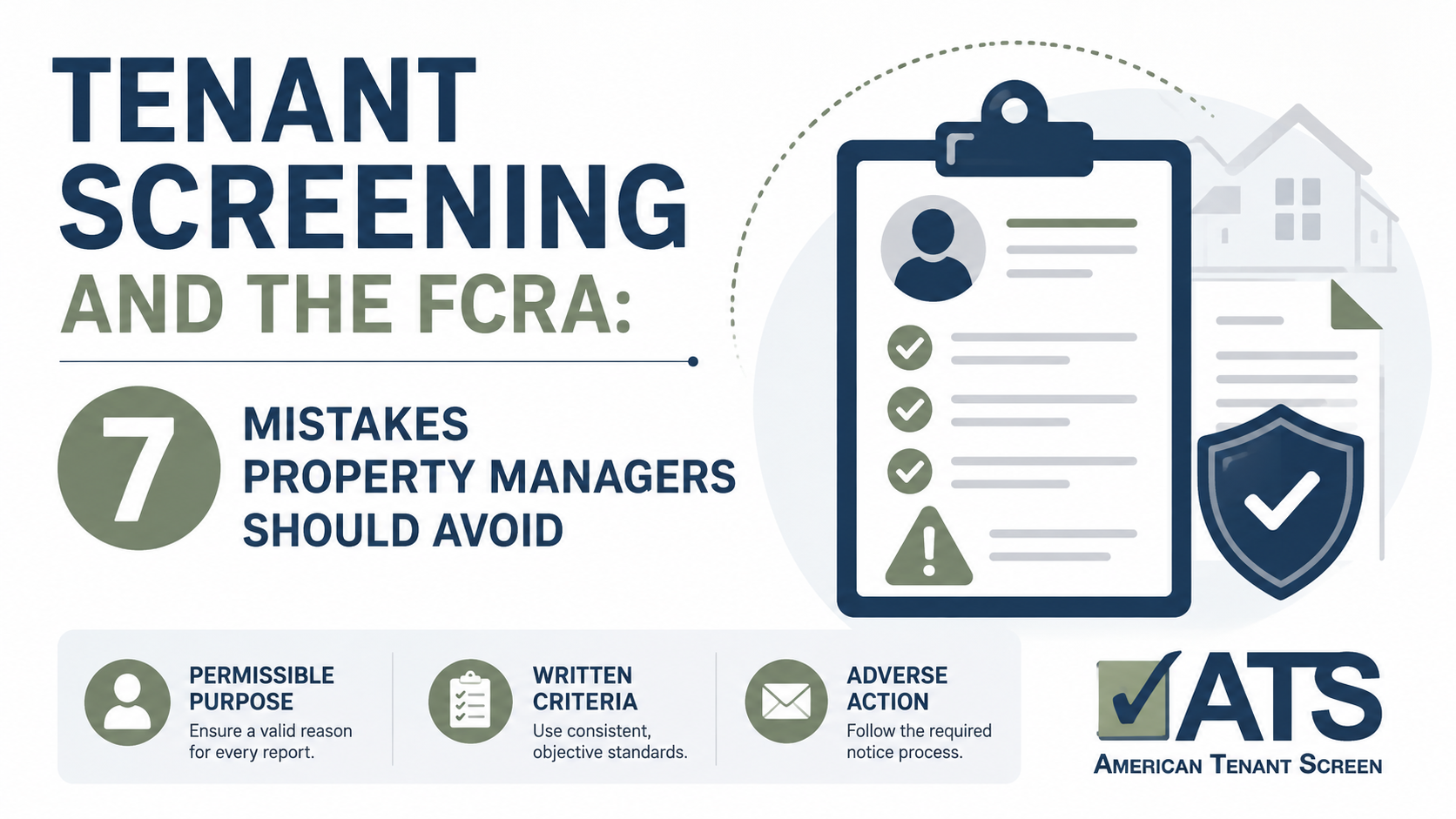
Tenant screening helps property managers make more informed rental decisions.
But when a housing provider uses a consumer report to evaluate an applicant, the Fair Credit Reporting Act—commonly known as the FCRA—can come into play.
That means tenant screening is not just an operational process.
It is also a compliance process.
Many mistakes do not happen because a property manager intends to do something wrong. They happen because procedures are unclear, staff members are not properly trained, or screening practices have evolved without anyone revisiting the policy.
Here are seven common FCRA-related mistakes property managers should work to avoid.
1. Ordering a Consumer Report Without a Permissible Purpose
A housing provider generally needs a permissible purpose under the FCRA to obtain a consumer report.
In the rental context, that usually means the report is being used in connection with a legitimate housing application or other authorized transaction.
The important point is that tenant screening reports should not be accessed casually.
Property managers should have procedures in place to make sure reports are ordered only for legitimate business purposes.
That includes controlling who has access to the screening system and making sure employees understand when reports may and may not be requested.
2. Failing to Clearly Define Screening Criteria
One of the most common screening problems begins before the report is even ordered.
If your organization does not have clear written rental criteria, staff members may interpret reports differently.
One leasing agent may consider a collection account significant.
Another may ignore it.
One property manager may focus heavily on credit score.
Another may look more closely at rental history.
That inconsistency can create operational and compliance concerns.
A stronger process establishes written standards that identify:
- What screening information will be considered
- What qualification standards apply
- How specific records are evaluated
- How exceptions, if any, are handled
- Who has authority to make final decisions
Written criteria can help keep decisions consistent across applicants and properties.
3. Treating Every Record as Automatically Disqualifying
A screening report may contain information that looks concerning at first glance.
But the existence of a record does not always mean the applicant should automatically be denied.
For example:
- A criminal case may have been dismissed
- An eviction filing may not have resulted in an eviction
- A debt may have been paid
- A record may belong to someone else with a similar name
- Information may be outdated or inaccurate
The report should be evaluated according to your established criteria and applicable law.
Tenant screening should not become a simple process of searching for anything negative.
The goal is to evaluate accurate, relevant information consistently.
4. Forgetting About Adverse Action Requirements
One of the most important FCRA responsibilities involves adverse action.
Many property managers understand that an adverse action notice may be required when an applicant is denied based in whole or in part on information contained in a consumer report.
But denial is not the only type of adverse action.
Depending on the circumstances, adverse action can also include offering less favorable rental terms because of information in a consumer report.
Examples may include:
- Requiring a larger security deposit
- Requiring a co-signer
- Charging a higher amount when permitted by law
- Approving the applicant only under additional conditions
If a consumer report contributed to the decision, the FCRA's adverse action requirements may apply.
That is why your screening process should clearly identify when an adverse action notice is required.
5. Providing an Incomplete Adverse Action Notice
An adverse action notice is not simply a letter saying:
“Your application was denied because of your background check.”
The notice generally needs to provide certain information so the applicant knows which consumer reporting agency supplied the report and understands their rights.
Depending on the situation, the notice should include information such as:
- The name of the consumer reporting agency
- The agency's contact information
- A statement explaining that the screening company did not make the rental decision
- Information about the applicant's right to obtain a copy of the report
- Information about the applicant's right to dispute inaccurate or incomplete information
Property managers should make sure their adverse action procedures are current and that staff members know how to use them.
6. Ignoring Applicant Disputes
An applicant may tell your leasing team:
“That record isn't mine.”
Or:
“That account was already paid.”
Or:
“I've never lived at that address.”
Those statements should not automatically be dismissed.
Consumer reports can contain errors.
Records can be mismatched.
Public databases can contain incomplete information.
Applicants have rights related to disputing information with consumer reporting agencies.
Your property management team should know how to direct applicants to the appropriate dispute process rather than attempting to investigate or correct the consumer report themselves.
It is also helpful to establish an internal procedure for situations where a screening decision is pending or an applicant raises a concern about the report.
7. Assuming the Screening Provider Handles All Compliance Responsibilities
A screening provider can be an important compliance resource.
But using a professional screening company does not automatically transfer every responsibility away from the housing provider.
The screening company is responsible for its obligations as a consumer reporting agency.
The housing provider is responsible for how it uses the information.
That includes areas such as:
- Establishing rental criteria
- Applying criteria consistently
- Using reports only for legitimate purposes
- Making rental decisions
- Providing required adverse action notices
- Following applicable federal, state, and local rules
A good screening provider can support the process, but it cannot replace your organization's policies or legal counsel.
Why Written Procedures Matter
Many FCRA mistakes are really process problems.
If your procedures live only in the memory of one experienced leasing manager, they are difficult to apply consistently.
A written screening policy can help define:
- When screening reports are ordered
- Who may access them
- Which criteria are reviewed
- How results are documented
- When adverse action notices are issued
- How applicant questions are handled
The more standardized the process becomes, the less likely individual employees are to improvise.
Don't Forget State and Local Requirements
The FCRA is a federal law, but it may not be the only rule affecting your screening process.
States and local jurisdictions may impose additional requirements related to:
- Criminal history
- Eviction records
- Credit information
- Application fees
- Screening disclosures
- Security deposits
- Income criteria
Some jurisdictions may significantly restrict how certain screening information can be used.
That is why housing providers with properties in multiple locations should avoid assuming that one screening policy works everywhere.
Training Matters Too
A well-written policy is only useful if employees understand it.
Leasing teams should know:
- What information they may consider
- What information they should not consider
- How to follow written rental criteria
- What to do when information is disputed
- When adverse action procedures apply
- Who to contact when they have questions
Periodic training can help reduce the risk of staff members creating their own unofficial screening practices.
The Bottom Line
FCRA compliance in tenant screening is not limited to the screening company that supplies the report.
Housing providers have an important role as well.
The strongest approach combines reliable screening information with written rental criteria, consistent procedures, employee training, and proper adverse action practices.
Key Takeaway
The goal is not simply to ask:
“Did we order the right report?”
It is also to ask:
“Are we using that report in a consistent and compliant way?”
A strong tenant screening program should address both questions.
This article is provided for general informational purposes and is not intended as legal advice. Housing providers should consult qualified counsel regarding their obligations under the Fair Credit Reporting Act and applicable state and local laws.
Lauren Walton
Director of Client Solutions
I have worked for ATS since 2010, and I am passionate about helping our clients utilize our services to their advantage to find the most qualified tenants and employees. I have a degree in Interior Design, and in my free time, I enjoy cooking, reading, visiting the beach, and spending time with my husband and our dog, Dixie.
Comments (0)
Be the first to comment.