
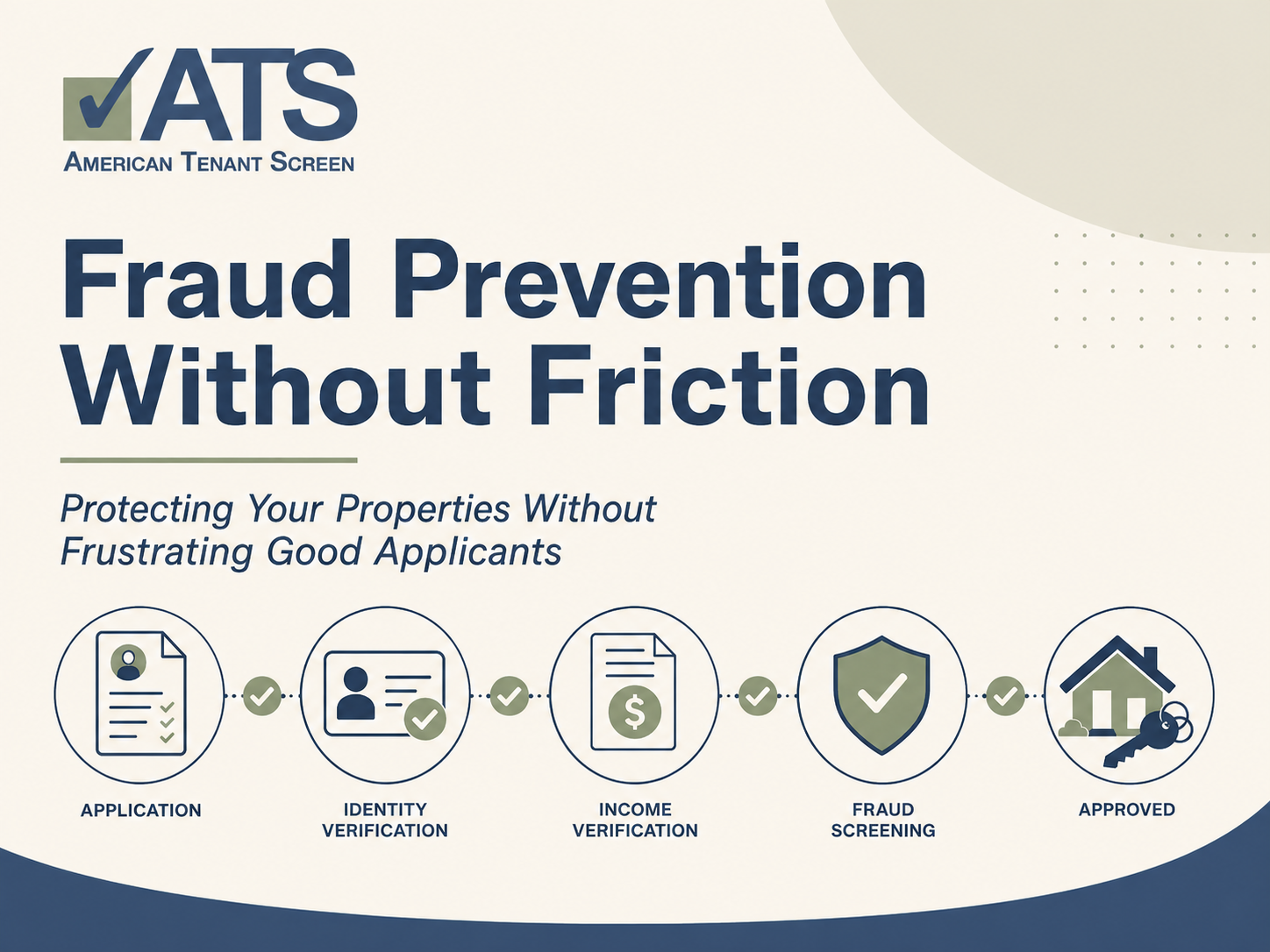
Fraud Prevention Without Friction: Protecting Your Properties Without Frustrating Good Applicants
 Lauren Walton·
Rental application fraud is becoming more sophisticated.
At the same time, legitimate applicants expect the leasing process to be fast, clear, and convenient.
That creates a challenge for property managers.
If screening is too loose, fraud can slip through.
If screening is too burdensome, qualified applicants may abandon the process, choose another property, or start the relationship feeling frustrated.
The goal is not to choose between security and convenience.
It is to build a screening process that delivers both.
Start With a Clear Application Process
One of the easiest ways to reduce applicant frustration is to explain the process upfront.
Applicants should know:
- What information they need to provide
- Which documents are required
- How identity will be verified
- How income will be evaluated
- How long the process typically takes
- What happens if more information is needed
Uncertainty creates friction.
When applicants understand the process, additional verification is less likely to feel arbitrary or personal.
Standardize What You Ask For
A common source of frustration occurs when applicants receive different instructions from different employees.
One leasing agent asks for two pay stubs.
Another asks for three months of bank statements.
A third requests an employment letter.
That inconsistency is frustrating for applicants and can create risk for the housing provider.
A better approach is to establish written standards for:
- Accepted income documentation
- Identity verification
- Employment verification
- Rental history
- Additional documentation
- Fraud-review procedures
The same standards should be applied consistently to similarly situated applicants.
Verify More, Request Less
Strong verification does not necessarily mean collecting more documents.
In some cases, better technology and clearer procedures can reduce the amount of information an applicant needs to upload.
For example, rather than asking an applicant to submit several different income documents, a property manager may be able to verify the underlying information through an approved verification process.
The goal should be to obtain enough reliable information to make the decision—not to collect paperwork for its own sake.
Avoid Making Every Applicant Feel Like a Suspect
Fraud awareness is important.
But a fraud-prevention strategy that treats every applicant as suspicious can create a poor customer experience.
Leasing staff should avoid language such as:
“We think these documents might be fake.”
Instead, the process can be framed as standard procedure:
“We verify income information for all applicants as part of our screening process.”
That small difference matters.
It keeps the focus on the policy rather than the individual.
Use Objective Triggers for Additional Verification
Sometimes additional review is appropriate.
The important question is what triggers that review.
A leasing team should not rely only on gut feeling.
Better triggers might include:
- Information that does not match across documents
- Income figures that conflict
- Identity information that cannot be verified
- Employer information that is inconsistent
- Missing required documentation
- Other predefined discrepancies
When the same types of inconsistencies trigger the same follow-up procedures, the process becomes more defensible and easier to manage.
Make Mobile Experience a Priority
Many rental applicants complete applications on their phones.
That means the screening experience should work well on a mobile device.
If applicants have to:
- Print forms
- Scan documents
- Resize files
- Send multiple emails
- Repeat information already entered elsewhere
the process can quickly become frustrating.
A streamlined digital workflow can reduce abandonment while still preserving important verification steps.
Don't Ask Applicants for Information You Don't Need
Every additional document creates more work for both the applicant and your team.
It can also increase the amount of sensitive information your organization has to protect.
Before requesting another document, ask:
What decision will this information help us make?
If the answer is unclear, the request may not be necessary.
A more focused process can improve both security and applicant experience.
Explain Why Verification Is Required
Applicants are often more cooperative when they understand the reason behind a request.
For example:
“We verify income information to make sure the same qualification standards are applied consistently to every applicant.”
That explanation is more reassuring than:
“We need more proof.”
Transparency can make additional verification feel like a normal part of the process rather than a sign that the applicant is being singled out.
Give Applicants Reasonable Alternatives
Not every applicant has the same type of documentation.
Some applicants are:
- Self-employed
- Retired
- Independent contractors
- Gig workers
- Commission-based employees
- New to the workforce
A process that accepts only one type of pay stub may create unnecessary obstacles.
Your policy should define reasonable alternative documentation for legitimate income types.
That keeps the process inclusive while maintaining consistent verification standards.
Speed Still Matters
Fraud prevention should not cause applications to sit untouched for days.
Applicants may be applying to several properties at once.
Slow processing can cost you qualified renters.
Property managers should look for delays in the workflow:
- Are applications waiting for manual review?
- Are staff members unclear about next steps?
- Are applicants being asked for the same information twice?
- Are screening reports being delayed because of incomplete submissions?
Reducing unnecessary delay can improve both leasing performance and applicant satisfaction.
Automation Can Help With Routine Tasks
Technology can be useful for:
- Checking whether required fields are complete
- Flagging inconsistent information
- Verifying identity
- Organizing documents
- Tracking application status
- Sending applicant reminders
Used correctly, automation can reduce the amount of repetitive work performed by leasing staff.
But automated systems should support your established procedures rather than creating unexplained barriers for applicants.
Make It Easy to Fix Simple Mistakes
Not every discrepancy is fraud.
Applicants mistype addresses.
They upload the wrong document.
They transpose numbers.
They forget to complete a field.
A good screening process should distinguish between a correctable mistake and information that requires deeper review.
Applicants should have a clear way to correct missing or inaccurate application information.
That can prevent unnecessary delays and frustration.
Train Leasing Staff on the Customer Experience
Fraud-prevention technology is only part of the process.
The leasing employee communicating with the applicant plays an equally important role.
Staff should know how to:
- Explain verification requirements
- Request additional documentation professionally
- Avoid accusatory language
- Escalate suspicious information
- Handle applicant questions
- Follow written procedures consistently
The same verification request can feel completely different depending on how it is communicated.
Measure Where Applicants Are Dropping Off
If your application process has multiple steps, pay attention to where applicants stop completing it.
For example:
- Do applicants abandon identity verification?
- Do they struggle with document uploads?
- Do they stop at income verification?
- Are certain instructions generating repeated questions?
Those patterns may identify unnecessary friction.
Fraud prevention should make the process more secure, but it should also be usable.
Don't Trade Accuracy for Convenience
There is another side to the balance.
In an effort to create a seamless experience, housing providers should not remove verification steps that are genuinely important.
The right goal is not:
Make the application as easy as possible.
It is:
Make the application as easy as possible without sacrificing reliable verification.
That is a much better standard.
The Bottom Line
Strong fraud prevention and a positive applicant experience are not opposites.
In fact, many of the same practices support both.
Clear procedures reduce confusion.
Standardized requirements improve consistency.
Better verification reduces unnecessary paperwork.
Technology can speed up routine tasks.
Professional communication builds trust.
Key Takeaway
The best fraud-prevention process should be difficult for a fraudster to manipulate—but easy for a legitimate applicant to complete.
Property managers should ask:
“Are we adding security, or are we just adding steps?”
If a step does not improve verification, consistency, or compliance, it may be creating friction without adding much value.
This article is provided for general informational purposes and is not intended as legal advice. Housing providers should ensure their application and screening procedures comply with applicable federal, state, and local requirements.
Lauren Walton
Director of Client Solutions
I have worked for ATS since 2010, and I am passionate about helping our clients utilize our services to their advantage to find the most qualified tenants and employees. I have a degree in Interior Design, and in my free time, I enjoy cooking, reading, visiting the beach, and spending time with my husband and our dog, Dixie.
Comments (0)
Be the first to comment.