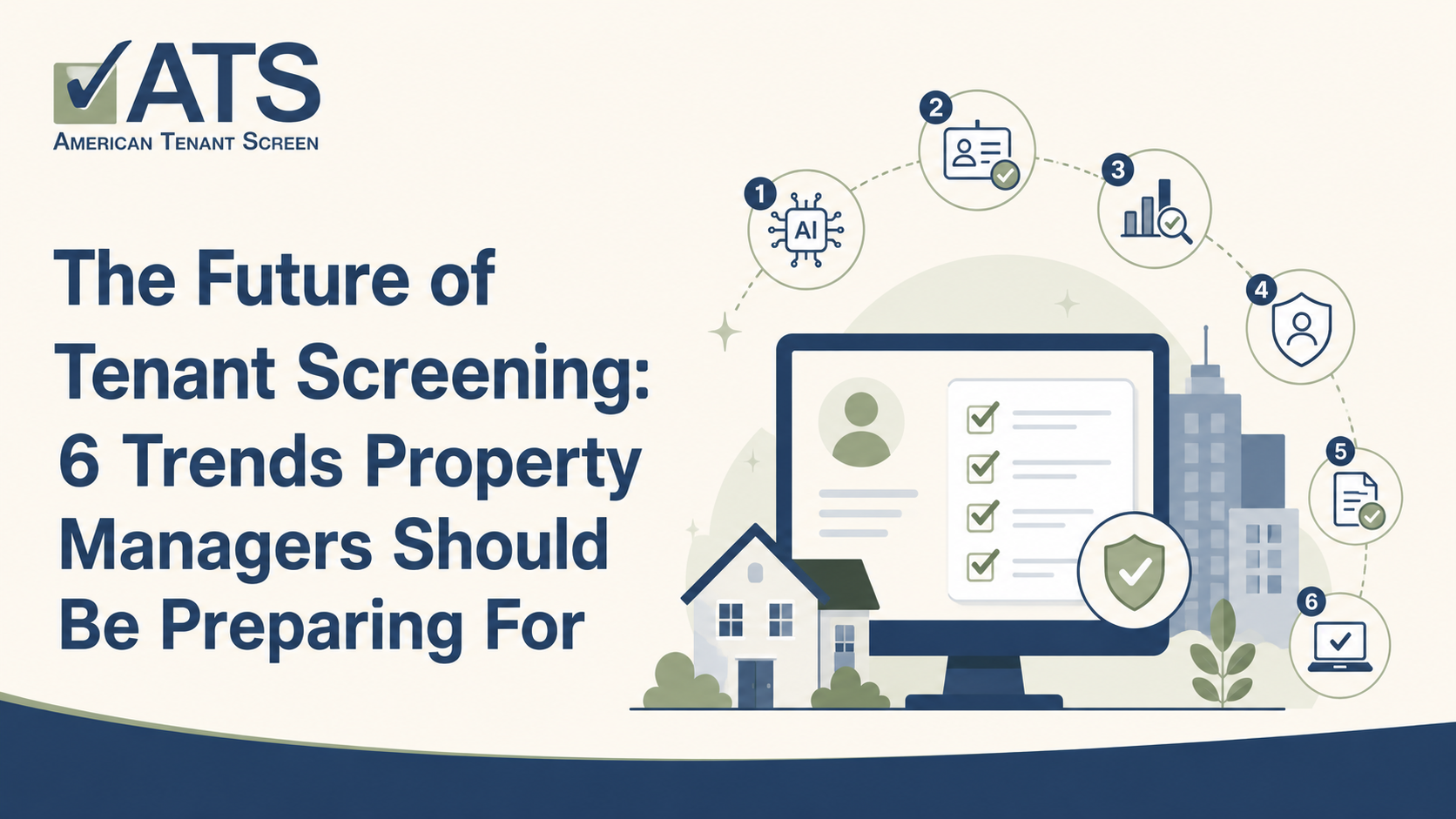
The Future of Tenant Screening: 6 Trends Property Managers Should Be Preparing For
 Lauren Walton·
Tenant screening has changed considerably in a relatively short period of time.
A process that once relied heavily on paper applications, photocopied identification, pay stubs, and phone calls to previous landlords is becoming increasingly digital.
At the same time, fraud is getting more sophisticated.
Artificial intelligence can help create convincing documents.
Property managers have access to more screening technology.
Applicants expect faster decisions.
And regulators continue to focus on issues such as accuracy and consumer-reporting practices.
So what comes next?
While nobody can predict exactly what tenant screening will look like several years from now, several trends are already taking shape.
Here are six worth watching.
Trend #1: Identity Verification Will Move Closer to the Beginning
Historically, tenant screening often focused primarily on:
- Credit
- Criminal records
- Eviction history
Identity was sometimes treated as a relatively simple administrative step.
That is changing.
The rise of stolen and synthetic identities means property managers increasingly need confidence that the person completing the application is actually the person being screened.
That may push identity verification earlier in the application process.
Before spending time evaluating income, credit, or rental history, housing providers may increasingly ask:
“Can we first verify who this applicant is?”
That makes sense.
Every other part of the screening report depends on identity being correct.
Trend #2: Income Verification Will Become Less Dependent on Uploaded Pay Stubs
Pay stubs are not disappearing.
But relying on uploaded documents alone is becoming more difficult.
AI and document-editing tools make financial records easier to manipulate, and industry providers are increasingly emphasizing integrated verification and fraud detection. Recent 2026 industry research continues to identify manipulated or AI-generated income documents as a concern in rental applications.
The next generation of income verification is likely to place more emphasis on confirming the underlying information rather than simply examining the appearance of a PDF.
That may include various forms of permissioned or independently verified data, depending on the service and applicant.
The shift is subtle but important.
The old question was:
“Does this pay stub look authentic?”
The emerging question is:
“Can this income be independently supported?”
Trend #3: Fraud Detection Will Become More Layered
There probably will not be one magic fraud score that solves rental application fraud.
Instead, screening is likely to combine multiple signals.
Those may include:
- Identity verification
- Income verification
- Document analysis
- Application consistency
- Contact information
- Device or application signals where lawfully and appropriately used
- Credit-related indicators
- Other fraud indicators
In June 2026, TransUnion released research examining a range of fraud indicators associated with negative rental outcomes, illustrating how the industry is increasingly looking beyond a single document or data point.
The key principle is likely to be layered verification.
One unusual data point may mean very little.
Several inconsistencies appearing together may justify additional review.
Trend #4: AI Will Help Review Applications—but Human Oversight Will Still Matter
Artificial intelligence is likely to become more common in property management.
Possible applications include:
- Reviewing documents
- Identifying discrepancies
- Organizing applicant information
- Detecting potential fraud
- Answering applicant questions
- Prioritizing applications requiring review
- Automating administrative workflows
Government research already recognizes that rental housing increasingly uses digital tools in areas including tenant screening, leasing, advertising, and property operations.
But the growth of automation does not mean property managers should blindly accept every machine-generated result.
The important questions will remain:
- What information is being used?
- How accurate is it?
- What does the result mean?
- Does it reflect our written rental criteria?
- Can the decision be reviewed?
- Can incorrect information be disputed?
The strongest systems will likely use AI as decision support, not an excuse to stop understanding how decisions are made.
Trend #5: Accuracy Will Become an Even Bigger Vendor Differentiator
For years, tenant screening companies often competed around:
- Price
- Turnaround time
- Number of searches
Those things will continue to matter.
But accuracy may become an increasingly important differentiator.
In July 2026, the FTC announced a $2.25 million settlement with RentGrow involving allegations related in part to procedures for assuring accuracy and handling disputes.
That type of enforcement action reinforces a broader point:
A large screening report is not useful if the information belongs to the wrong consumer or does not accurately reflect the underlying record.
Property managers may therefore increasingly evaluate screening providers by asking:
- How are records matched?
- How are potential duplicate records handled?
- How are data sources updated?
- What happens when an applicant disputes something?
- How quickly are corrections processed?
- Can the provider explain where information came from?
“More data” may become less compelling than better verified data.
Trend #6: Screening Will Become More Integrated With the Leasing Experience
Tenant screening has traditionally been treated as a separate step:
Application submitted.
Screening ordered.
Report returned.
Decision made.
That process is increasingly becoming integrated into a broader digital leasing workflow.
Future systems may connect:
- Marketing
- Scheduling
- Applications
- Identity verification
- Income verification
- Screening
- Applicant communication
- Lease generation
- Move-in procedures
This integration can potentially reduce duplicate data entry and manual handoffs.
It may also make applications faster for legitimate renters.
But integration creates another responsibility:
Property managers need to understand which systems are making which decisions.
A convenient workflow should not become an invisible decision-making process.
Bonus Trend: Applicants Will Expect More Transparency
The more sophisticated screening becomes, the more applicants may want to know what is happening.
If an applicant is asked to:
- Verify their identity
- Connect financial information
- Upload sensitive records
- Complete automated verification
- Authorize screening
they are likely to have questions.
What is being collected?
Why is it needed?
Who receives it?
What happens if something is wrong?
Transparency can become a competitive advantage.
A property manager who clearly explains the process may create more trust than one who simply sends the applicant through a series of unexplained screens.
Bonus Trend: Screening Policies Will Need More Frequent Reviews
Technology is changing quickly.
So are fraud tactics.
Legal requirements can also change at the federal, state, and local levels.
That means the traditional approach of reviewing the screening policy every few years may become insufficient.
Organizations may need to review screening programs whenever they:
- Introduce new technology
- Change screening vendors
- Add new data sources
- Enter new jurisdictions
- Update qualification criteria
- Experience a rise in applicant disputes
- Identify new fraud patterns
Tenant screening is becoming an ongoing operational discipline rather than a static background-check procedure.
What Probably Won't Change
With all this technology, it is easy to assume tenant screening will eventually become completely automated.
But several fundamentals are unlikely to disappear.
Property managers will still need:
Reliable information.
Clear rental criteria.
Consistent procedures.
Accurate identity matching.
Appropriate documentation.
A process for disputes.
Compliance with applicable law.
Technology may change how those things are accomplished.
It does not eliminate the need for them.
What Property Managers Can Do Now
You do not need to predict exactly what screening technology will look like five years from now.
You can prepare by strengthening the fundamentals today.
Ask:
- Are we verifying applicant identity effectively?
- Are we overly dependent on uploaded income documents?
- Do we understand how our screening provider handles record matching?
- Can our employees explain an automated screening result?
- Do applicants have a clear dispute path?
- Are our rental criteria written and current?
- Are we reviewing our screening vendors regularly?
- Are we monitoring changes in the jurisdictions where we operate?
Organizations that can answer those questions confidently will be better positioned to adopt new technology responsibly.
Don't Chase Technology for Its Own Sake
Every year will bring new screening products promising:
- Faster decisions
- Better fraud detection
- Smarter AI
- More automation
- Larger databases
Some will deliver meaningful improvements.
Others may simply add another layer of complexity.
Property managers should evaluate new tools by asking whether they improve one or more of the things that actually matter:
- Accuracy
- Verification
- Consistency
- Efficiency
- Applicant experience
- Security
- Compliance support
Technology should solve a problem.
It should not become the problem.
The Future Will Likely Be “Verify, Then Screen”
One of the biggest changes may ultimately be philosophical.
Traditional screening often begins by searching for information about the applicant.
The emerging process is increasingly likely to begin by verifying the applicant and the information they supplied.
Verify the identity.
Verify the income.
Confirm the application information.
Then evaluate relevant screening records.
That approach reflects the changing nature of rental fraud.
When documents and identities can be manipulated more easily, verification becomes just as important as the search itself.
The Bottom Line
The future of tenant screening will probably involve more technology, more automation, stronger identity tools, increasingly sophisticated fraud detection, and greater integration with the leasing process.
But the best screening programs will not simply be the ones using the newest technology.
They will be the ones that use technology thoughtfully.
Key Takeaway
Property managers preparing for the future should focus on one principle:
Use technology to improve the reliability of your decisions—not simply to make decisions faster.
The tools will continue to change.
The objective remains the same:
Accurately identify the applicant, verify relevant information, apply clear criteria consistently, and make informed rental decisions using reliable data.
That foundation will remain valuable no matter what the next generation of tenant screening looks like.
This article is provided for general informational purposes and is not intended as legal advice. Tenant screening technology, regulations, agency policies, and state and local requirements continue to evolve. Housing providers should consult qualified legal counsel and periodically review their screening practices and technology.
Lauren Walton
Director of Client Solutions
I have worked for ATS since 2010, and I am passionate about helping our clients utilize our services to their advantage to find the most qualified tenants and employees. I have a degree in Interior Design, and in my free time, I enjoy cooking, reading, visiting the beach, and spending time with my husband and our dog, Dixie.
Comments (0)
Be the first to comment.