
The Hidden Cost of a Bad Rental Application
 Lauren Walton·
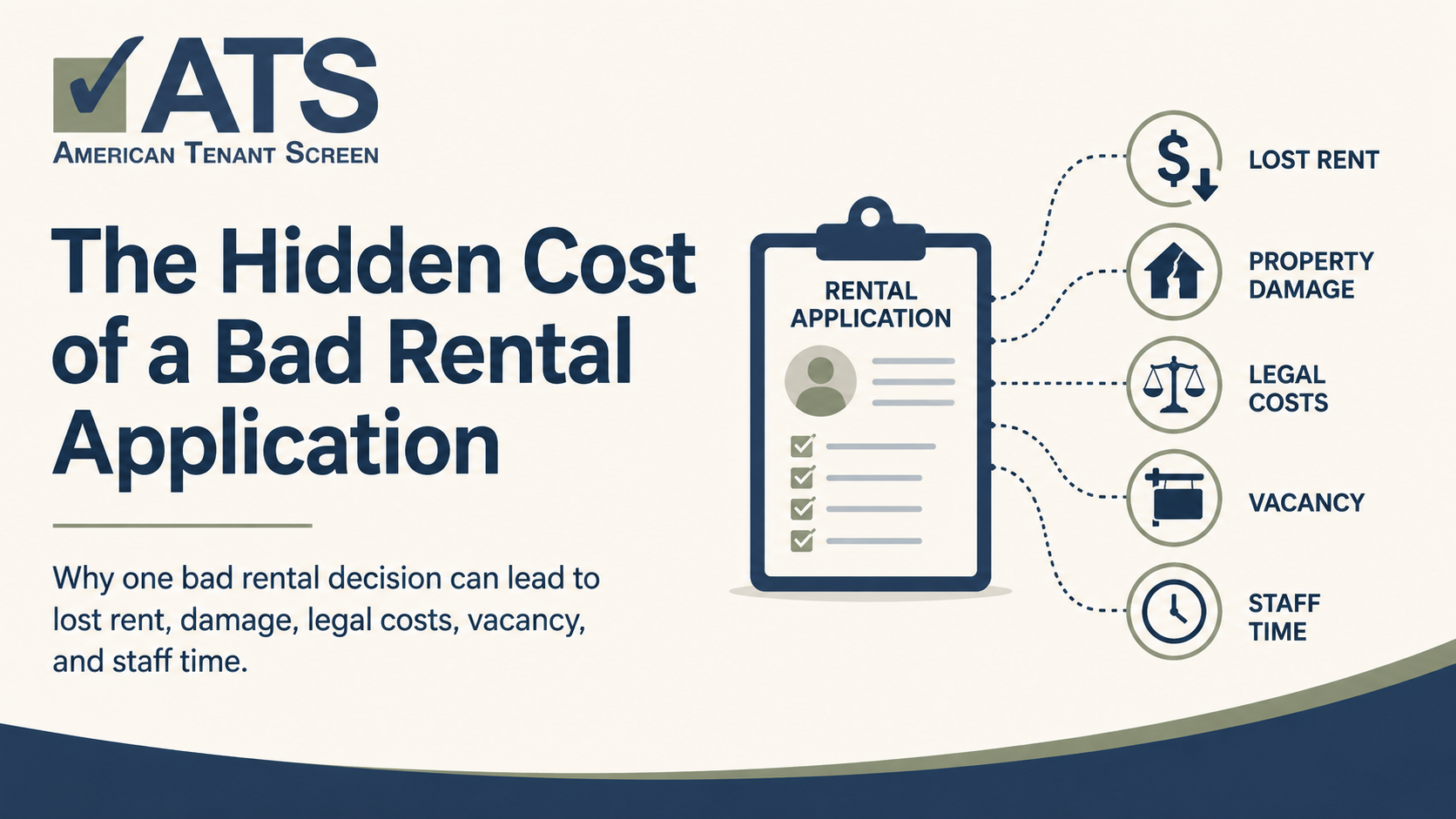
A bad rental application can cost a property manager much more than one missed rent payment.
If inaccurate information slips through the screening process, the financial impact can spread across the entire property operation.
There may be unpaid rent.
There may be legal expenses.
There may be damage to the unit.
There may be staff time spent resolving problems.
And once the resident leaves, there may be additional vacancy and turnover costs before the unit begins producing income again.
That is why tenant screening should not be viewed as just another administrative step.
It is part of a broader risk-management process.
What Do We Mean by a “Bad” Rental Application?
A bad rental application does not necessarily mean the applicant is a bad person.
It means the information used to make the rental decision may be inaccurate, incomplete, misleading, fraudulent, or inconsistent with the housing provider's established qualification criteria.
Examples could include:
- False income information
- Altered pay stubs
- Fake employment
- Synthetic or stolen identity information
- Misrepresented rental history
- Undisclosed information relevant to established criteria
- Records belonging to another person
- Incomplete or inaccurate application information
The danger is not simply the application itself.
It is what happens when unreliable information leads to an unreliable decision.
Cost #1: Unpaid Rent
The most obvious potential loss is unpaid rent.
Suppose an applicant significantly exaggerates income in order to meet the property's qualification standard.
The applicant may be approved based on income that does not actually exist.
If the rent later becomes unaffordable, the housing provider may experience:
- Late payments
- Partial payments
- Missed payments
- Collection activity
- Legal proceedings
Even one month of unpaid rent can be significant.
Several months can quickly turn into a much larger financial loss.
Cost #2: Legal and Eviction Expenses
When a tenancy deteriorates, property managers may incur legal costs.
Depending on the situation and jurisdiction, those costs can include:
- Attorney fees
- Court filing fees
- Service fees
- Administrative time
- Documentation preparation
- Collection expenses
The process can also take time.
While a legal matter is pending, the unit may continue producing little or no rental income.
That means the true cost is often greater than the legal bill.
Cost #3: Vacancy
Eventually, the resident may leave or possession of the unit may be recovered.
Now the property has another problem:
The unit is vacant.
A vacant apartment represents lost revenue every day it is not occupied.
If turnover takes several weeks, the property may lose an additional month of rent—or more—before a new resident moves in.
Vacancy is one of the hidden costs that property managers sometimes overlook when evaluating the financial impact of a poor leasing decision.
Cost #4: Turnover Expenses
A vacant unit usually needs work before it can be rented again.
Common turnover expenses may include:
- Cleaning
- Painting
- Carpet or flooring work
- Repairs
- Lock changes
- Maintenance labor
- Trash removal
- Inspections
- Marketing
Even a relatively normal turnover costs money.
If the unit has been damaged, those costs can increase substantially.
Cost #5: Property Damage
Most residents take reasonable care of their homes.
But when serious property damage occurs, the cost can be significant.
Damage might involve:
- Walls
- Flooring
- Appliances
- Fixtures
- Doors
- Cabinets
- Plumbing
- Common areas
Security deposits may cover some losses where permitted, but they may not cover everything.
Damage can also extend the turnover period, creating additional vacancy.
Cost #6: Staff Time
This cost is easy to miss because it rarely appears as a separate invoice.
But staff time is expensive.
A problematic tenancy may require hours of work from:
- Property managers
- Leasing teams
- Maintenance staff
- Accounting staff
- Regional managers
- Legal teams
Employees may spend time:
- Calling the resident
- Reviewing payment records
- Documenting incidents
- Coordinating repairs
- Communicating with attorneys
- Preparing notices
- Attending court
- Managing turnover
Those hours could have been spent on leasing, resident service, maintenance planning, or other productive work.
Cost #7: Lost Leasing Opportunities
A questionable applicant can also create opportunity costs.
Suppose a unit is leased to someone whose application contained inaccurate information.
A qualified applicant may have been turned away because the unit was no longer available.
If the original tenancy fails shortly afterward, the property may need to market the same unit again.
Now the housing provider has lost both time and a potentially stronger leasing opportunity.
Cost #8: Fraudulent Payments
Application fraud does not always stop at the application.
A fraudster may also attempt to use:
- Fraudulent checks
- Stolen payment information
- Reversed electronic payments
- Other questionable payment methods
A housing provider may believe rent or a deposit has been paid only to discover later that the payment cannot be collected.
By then, possession of the unit may already have been transferred.
Cost #9: Reputation
Resident problems can affect more than one unit.
Ongoing disputes, property damage, unauthorized occupancy, or disruptive behavior can affect the experience of neighboring residents.
That can lead to:
- Resident complaints
- Negative online reviews
- Additional staff involvement
- Renewal concerns
- Reputation damage
The financial impact of reputation problems can be difficult to measure, but it can still be real.
The Cost of Screening Errors Works Both Ways
There is another important side to this discussion.
Poor screening is not only a risk when an unqualified applicant is approved.
It can also be costly when a qualified applicant is incorrectly denied.
If a screening report contains inaccurate information, the property may lose a good prospective resident.
The applicant may choose another community.
The unit may remain vacant.
Staff may spend additional time handling a dispute.
That is why quality tenant screening should focus on both:
Identifying relevant risk accurately
and
Avoiding incorrect decisions based on bad data.
Better Screening Is Not About Finding Reasons to Deny People
A strong screening process should not be designed to find as many negative records as possible.
That approach misses the point.
The goal is to obtain reliable information and determine whether the applicant meets clearly established rental criteria.
A good screening process may include:
- Identity verification
- Income verification
- Credit information
- Rental history
- Eviction-related information
- Criminal-history information where applicable
- Other relevant and lawful criteria
Each component should serve a clear purpose.
Fraud Prevention Can Reduce Avoidable Losses
Many application problems begin with information that could not be verified.
Examples include:
- An employer that does not exist
- Income that cannot be confirmed
- Identity information that does not match
- References that cannot be independently verified
- Documents containing conflicting information
Consistent verification procedures can help identify these problems before the lease is signed.
That does not mean every discrepancy is fraud.
It means the discrepancy should be resolved according to an established process.
Cheap Screening Can Become Expensive Screening
Price matters when choosing a tenant screening provider.
But it should not be the only consideration.
A lower-cost report may not be a good value if it results in:
- Incomplete information
- Poor record matching
- Weak customer support
- Frequent disputes
- Additional manual work
- Inaccurate decisions
The cost difference between two screening services may be relatively small.
The cost difference between two leasing outcomes can be enormous.
Ask What a Bad Decision Could Cost
Instead of focusing only on the price of the report, property managers may want to ask:
- What would one month of unpaid rent cost us?
- What does an average turnover cost?
- What does an eviction typically cost?
- How much staff time is involved?
- What is the cost of an additional month of vacancy?
Those numbers help put screening expenses into perspective.
A small investment in reliable verification can look very different when compared with the cost of one preventable loss.
Screening Should Still Be Efficient
None of this means property managers should create an unnecessarily complicated application process.
Excessive documentation can frustrate qualified applicants and slow leasing.
The goal is not maximum friction.
It is appropriate verification.
A good process asks for what is necessary, validates important information, and makes decisions efficiently.
The Bottom Line
A rental application may seem like paperwork.
But the decision attached to that application can affect thousands of dollars in revenue and expenses.
Unpaid rent, legal costs, vacancy, turnover, damage, staff time, and lost leasing opportunities can quickly add up.
That is why tenant screening should be viewed as part of the property's financial risk-management strategy.
Key Takeaway
The real question is not:
“How much does tenant screening cost?”
It is:
“What could one bad rental decision cost?”
When viewed that way, accurate and consistent screening becomes less of an administrative expense and more of an investment in better decision-making.
This article is provided for general informational purposes and is not intended as legal advice. Housing providers should develop screening procedures in accordance with applicable federal, state, and local requirements.
Lauren Walton
Director of Client Solutions
I have worked for ATS since 2010, and I am passionate about helping our clients utilize our services to their advantage to find the most qualified tenants and employees. I have a degree in Interior Design, and in my free time, I enjoy cooking, reading, visiting the beach, and spending time with my husband and our dog, Dixie.
Comments (0)
Be the first to comment.