
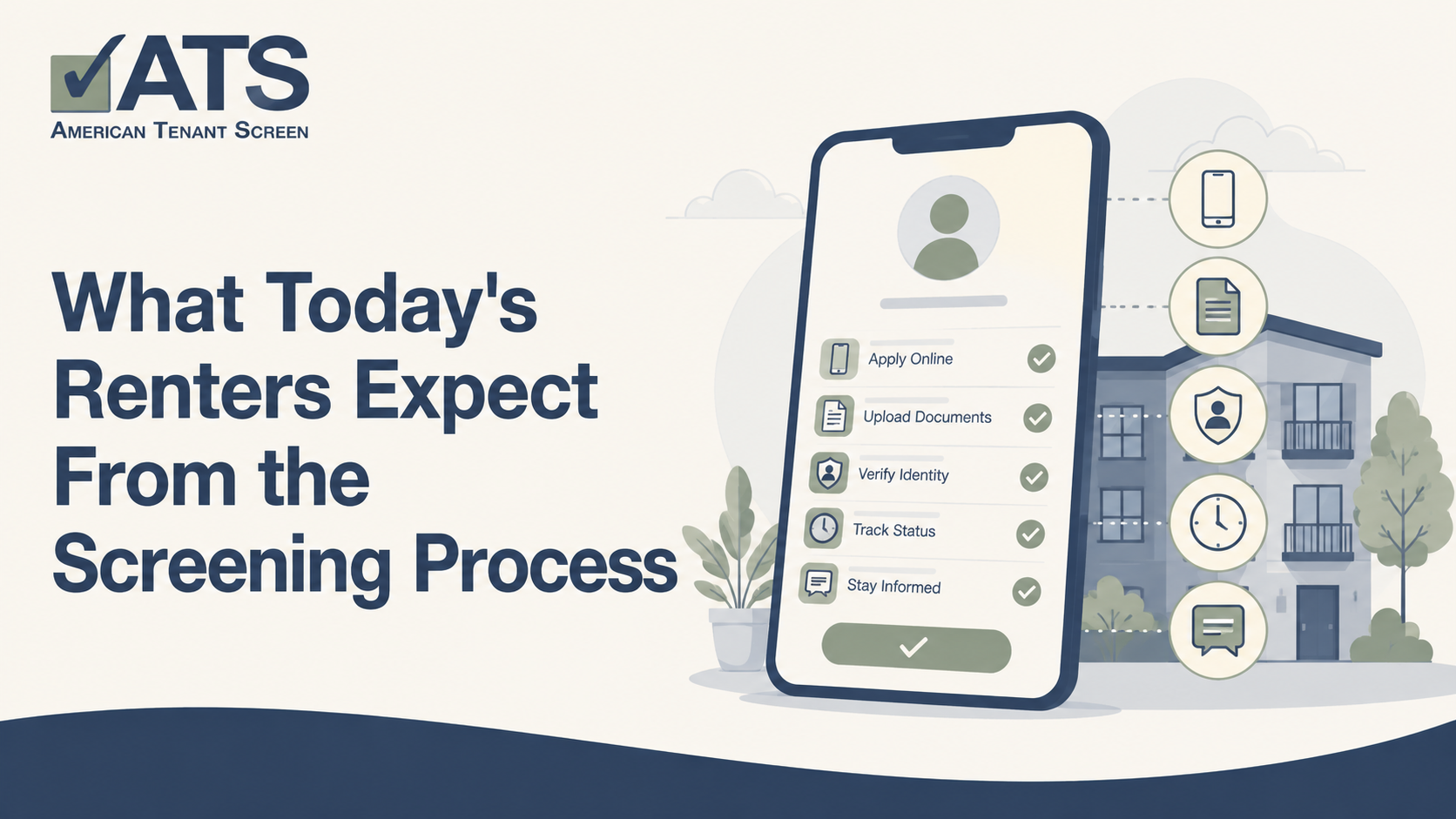
What Today's Renters Expect From the Screening Process
 Lauren Walton·
Tenant screening is often discussed from the property manager's perspective.
Does the applicant meet the income requirement?
Can their identity be verified?
What does the screening report show?
Are there inconsistencies in the application?
Those questions are important.
But there is another perspective worth considering:
What does the screening process feel like to the applicant?
Today's renters are increasingly accustomed to digital experiences that are fast, transparent, mobile-friendly, and easy to understand.
They can apply for a credit card online.
They can open a bank account from their phone.
They can book travel in minutes.
So when a rental application requires repeated emails, unclear documentation requests, long periods without updates, or multiple disconnected systems, the experience can feel outdated.
Property managers still need reliable screening.
The challenge is delivering that screening without creating unnecessary friction for qualified applicants.
Expectation #1: A Digital Application Process
Many prospective renters expect to complete most or all of the application process online.
That includes:
- Submitting the application
- Uploading documentation
- Verifying identity
- Providing income information
- Paying permitted application fees
- Receiving updates
- Signing documents
Rental housing technology is increasingly used across the leasing journey, including tenant screening and other property-management functions.
A digital process does not simply benefit the renter.
It can also reduce manual data entry, missing paperwork, and administrative work for leasing teams.
Expectation #2: The Process Should Work on a Phone
A digital application is not necessarily a good digital application.
If applicants need a desktop computer to complete every step, the process may still create unnecessary barriers.
Many renters will interact with your property primarily through a smartphone.
That means application workflows should make it reasonably easy to:
- Enter information
- Upload documents
- Verify identity
- Read instructions
- Respond to requests
- Check application status
Property managers should periodically test their own application process from a mobile device.
You may discover friction your leasing team never sees from the administrative side.
Expectation #3: Clear Qualification Standards
Applicants want to know what they are being evaluated on.
Few things are more frustrating than paying an application fee and submitting sensitive information without understanding the basic qualification standards.
Where appropriate and consistent with applicable requirements, property managers should clearly communicate information such as:
- Income requirements
- Credit criteria
- Documentation requirements
- Identification requirements
- Guarantor policies
- Rental-history requirements
- Other relevant qualification standards
Transparency can help applicants determine whether the property is likely to be a good fit before completing the entire process.
It can also reduce questions for your leasing team.
Expectation #4: Don't Ask for the Same Information Three Times
A common source of frustration is duplication.
An applicant enters their employment information on the application.
Then they upload pay stubs.
Then they receive an email asking them to type the employment information again.
Then someone from the leasing office calls asking for the same details.
Some duplication may be necessary for verification.
But unnecessary repetition makes the process feel disorganized.
Property managers should look for opportunities to integrate application and screening systems so information flows more efficiently.
The goal should be:
Collect information once when possible, then verify it appropriately.
Expectation #5: Explain Why Sensitive Information Is Needed
Rental applications involve highly sensitive information.
Applicants may be asked to provide:
- Social Security numbers
- Identification
- Financial documentation
- Employment information
- Previous addresses
- Other personal data
It is reasonable for applicants to want to know why that information is required.
Simple explanations can make the process feel much more trustworthy.
For example:
“We use this information to verify your identity and complete the tenant screening process.”
That is better than providing no explanation at all.
Expectation #6: Keep Them Updated
An applicant may understand that screening takes time.
What is harder to tolerate is not knowing what is happening.
Imagine submitting an application and hearing nothing for three days.
Has the application been received?
Is information missing?
Is the screening report pending?
Has the unit already been rented?
A simple status update can dramatically improve the experience.
Useful notifications might include:
- Application received
- Additional information required
- Screening in progress
- Verification pending
- Application complete
- Decision available
Technology can automate many of these communications.
Expectation #7: Don't Assume an Unusual Income Situation Is a Problem
The traditional applicant who works one W-2 job and receives the same paycheck every two weeks is no longer the only common income profile.
Applicants may be:
- Self-employed
- Freelancers
- Independent contractors
- Gig workers
- Commission-based employees
- Retired
- Receiving income from multiple lawful sources
A rigid process that accepts only one traditional pay-stub format can create unnecessary difficulty.
Housing providers should establish appropriate procedures for evaluating different legitimate income structures and apply them consistently.
Expectation #8: Give Applicants a Way to Correct Mistakes
People make mistakes on applications.
An applicant may:
- Enter the wrong address
- Transpose a number
- Upload an outdated pay stub
- Miss a required field
- Accidentally provide an old employer's information
Not every discrepancy is fraud.
A good process gives legitimate applicants a reasonable way to correct or clarify information.
That does not mean ignoring inconsistencies.
It means having a standardized method for resolving them.
Expectation #9: Screening Reports Should Be Accurate
Applicants reasonably expect decisions about housing to be based on information that actually belongs to them.
Unfortunately, consumer reports can sometimes contain mistakes.
The FTC specifically advises renters that tenant background reports can contain incorrect information and explains consumers' rights to obtain reports and dispute inaccuracies.
Recent enforcement activity has also reinforced the importance of accuracy. In July 2026, the FTC announced a $2.25 million settlement involving allegations that tenant screening provider RentGrow failed to maintain reasonable procedures to assure maximum possible accuracy and mishandled certain consumer disputes.
For property managers, the practical lesson is straightforward:
Your applicant should have a clear way to address information they believe is wrong.
Expectation #10: A Human Should Be Reachable
Automation can make leasing more efficient.
But there are moments when applicants need a person.
For example:
“My identity verification isn't working.”
“My income documents are being rejected.”
“That eviction record isn't mine.”
“I received a notice and don't understand what it means.”
A chatbot or automated email may handle routine questions.
But difficult situations should have a clear escalation path.
The strongest leasing experience combines efficient technology with accessible human support.
Expectation #11: Decisions Should Feel Consistent
Applicants may not know your internal screening policy.
But they notice when the process seems arbitrary.
For example:
“My friend applied here last month and wasn't asked for this.”
“Why do I need three documents when someone else needed one?”
Consistency helps reduce those concerns.
Your screening standards should define:
- Which documents are required
- When additional verification occurs
- How income is calculated
- How discrepancies are resolved
- How conditional approvals work
- Who may approve exceptions
The more clearly those procedures are established, the easier they are to explain.
Expectation #12: If the Decision Is Unfavorable, Tell Them What Happens Next
If information from a consumer report contributes to an unfavorable rental decision, FCRA adverse-action requirements may apply.
The FTC explains that adverse action can include not only denial but also actions such as requiring a co-signer or increasing a deposit based in whole or in part on information in a consumer report.
Applicants should receive the required information so they understand which consumer reporting agency supplied the report and how they may obtain or dispute it.
A clear adverse-action process is both a compliance issue and an applicant-experience issue.
Security and Convenience Should Work Together
There can be a temptation to view fraud prevention and applicant experience as competing priorities.
They do not have to be.
In fact, many strong fraud controls can make the experience better.
Digital identity verification can reduce paperwork.
Integrated income verification can reduce repeated documentation requests.
Automated status updates can reduce phone calls.
Standardized workflows can eliminate inconsistent requests.
The goal is not fewer controls.
It is smarter controls.
Try Your Own Application Process
One of the simplest exercises a property management company can perform is completing its own rental application.
Go through the entire process as though you were an applicant.
Try it on a phone.
Ask:
- Are the instructions clear?
- How many times do I enter the same information?
- Is it obvious which documents I need?
- Do I understand why information is requested?
- Are there dead ends?
- Do I receive confirmation?
- Do I know who to contact if something goes wrong?
You may find opportunities to improve the process without changing your qualification standards at all.
A Better Applicant Experience Can Benefit Property Managers Too
Removing unnecessary friction can benefit your leasing operation.
A clearer process may mean:
- Fewer incomplete applications
- Fewer applicant questions
- Less staff follow-up
- Faster verification
- Fewer abandoned applications
- Better communication
- More consistent screening
Applicant experience is therefore not simply a customer-service project.
It can also be an operational-efficiency project.
The Bottom Line
Today's renters expect technology to make processes easier.
Tenant screening still requires careful verification, reliable information, and consistent rental criteria.
But those goals do not require a confusing or frustrating application experience.
Key Takeaway
Property managers should ask:
“If I were applying for this apartment myself, would this process feel clear, reasonable, and professional?”
The best screening experience protects the housing provider while making it straightforward for legitimate applicants to demonstrate that they meet the property's established criteria.
That is good screening—and good leasing.
This article is provided for general informational purposes and is not intended as legal advice. Housing providers should develop applicant-screening and communication procedures consistent with applicable federal, state, and local requirements.
Lauren Walton
Director of Client Solutions
I have worked for ATS since 2010, and I am passionate about helping our clients utilize our services to their advantage to find the most qualified tenants and employees. I have a degree in Interior Design, and in my free time, I enjoy cooking, reading, visiting the beach, and spending time with my husband and our dog, Dixie.
Comments (0)
Be the first to comment.