
Why Faster Isn't Always Better When It Comes to Tenant Screening
 Lauren Walton·
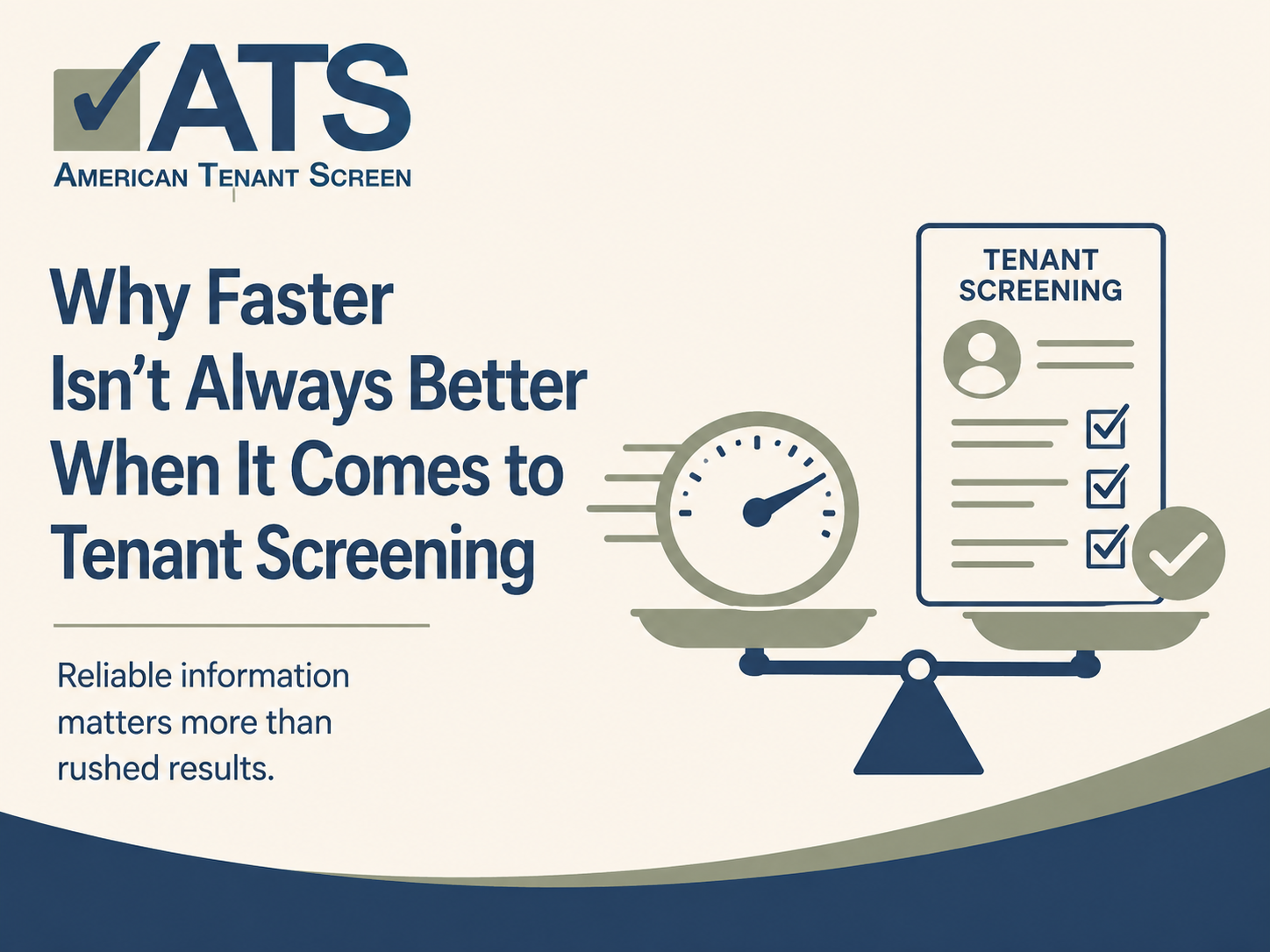
Speed matters in property management.
Every day a unit sits vacant can represent lost revenue.
Applicants want quick answers.
Leasing teams want to keep the process moving.
So it is understandable that tenant screening companies often emphasize fast turnaround times.
Instant results sound ideal.
But there is an important distinction:
Fast screening and good screening are not always the same thing.
Some information can be returned almost immediately.
Other records may require verification, courthouse research, or additional review.
When accuracy matters, the fastest result is not always the best result.
Why Property Managers Want Fast Screening
The benefits of fast turnaround are obvious.
Faster screening can help:
- Reduce vacancy time
- Improve applicant experience
- Increase leasing efficiency
- Keep applicants from choosing competing properties
- Reduce staff follow-up
- Move qualified applicants toward approval quickly
Those are all legitimate operational goals.
The problem occurs when speed becomes the only measure of screening quality.
Some Searches Can Be Instant
Many screening components can be processed quickly.
For example, certain electronic databases may return results in seconds.
Automated systems may be able to review:
- Identity information
- Credit data
- Database records
- Application information
- Certain income data
That can be very useful.
But not every source works the same way.
Court Records Can Be Complicated
Criminal and eviction information often comes from courts.
Court systems vary significantly.
Some provide:
- Real-time electronic access
- Detailed identifiers
- Complete dispositions
Others may require:
- Manual research
- Clerk assistance
- Additional verification
- Local courthouse access
A provider that promises every search will be instant may be relying heavily on databases rather than verifying information at the underlying source when additional research is appropriate.
That does not automatically mean the search is inadequate.
It does mean property managers should understand what they are buying.
A Possible Match May Need Verification
Imagine a database returns a criminal record for someone with the same first and last name as your applicant.
The date of birth is similar.
But other identifying information is incomplete.
An instant system could simply report the possible match.
A more careful process might take additional time to determine whether the record actually belongs to the applicant.
That extra time can be valuable.
A fast wrong answer is still a wrong answer.
Database Searches Have Strengths and Limitations
Large databases can be extremely useful.
They can quickly identify possible records across many jurisdictions.
But they may not contain every record, and information may not always be updated at the same time as the original court source.
Property managers should ask:
- Where does the data come from?
- How often is it updated?
- Are possible matches verified?
- Are courthouse searches used when appropriate?
- Are case dispositions reviewed?
The phrase “instant nationwide search” should not be the end of the conversation.
It should be the beginning of a few more questions.
Accuracy Can Save Time Later
A rushed screening decision may actually create more work.
Suppose an applicant is denied because of a record that belongs to someone else.
Now your team may have to deal with:
- An applicant complaint
- A consumer dispute
- Additional communication
- A corrected report
- Reconsideration of the application
- A delayed leasing decision
A few extra hours of verification upfront may have prevented days of confusion.
Accuracy and efficiency are not necessarily opposites.
Sometimes better accuracy creates greater efficiency.
Applicants Want Fast Decisions—But They Also Want Correct Decisions
From the applicant's perspective, speed matters.
But accuracy matters more.
An applicant would probably rather wait a little longer than be incorrectly denied because of someone else's record.
The goal should therefore be:
Fast when the information is clear. Careful when it isn't.
That is a more realistic standard than expecting every application to be completed instantly.
Not Every Delay Is a Problem
Some delays are unnecessary.
Others are signs that verification is working.
For example, additional time may be required because:
- A court record needs clarification
- A possible identity match needs review
- The applicant submitted inconsistent information
- A jurisdiction requires manual research
- An employment verification is pending
- A record's disposition is unclear
The key is distinguishing between productive verification time and avoidable operational delay.
Avoidable Delays Should Still Be Fixed
While faster is not always better, slower is not automatically better either.
Property managers should identify unnecessary bottlenecks.
Common examples include:
- Applications sitting in an employee's inbox
- Staff not knowing who handles exceptions
- Applicants receiving unclear instructions
- Duplicate documentation requests
- Delayed internal approvals
- Manual processes that could be automated
Those delays do not improve accuracy.
They simply create friction.
Set Realistic Expectations With Applicants
If most screening reports return quickly but certain searches take longer, tell applicants.
For example:
“Most applications are processed promptly, but some records may require additional verification.”
That is better than promising instant results and then leaving the applicant wondering why the application has been delayed.
Clear expectations improve the applicant experience.
Ask Your Screening Provider About Turnaround Time
Instead of asking only:
“How fast are your reports?”
ask:
- Which searches are typically instant?
- Which may require additional research?
- What causes delays?
- How are clients notified when a search is pending?
- Are records verified before they are reported?
- What happens when identifying information is incomplete?
- How are court closures or access issues handled?
Those questions provide a better picture of actual service quality.
Look at Accuracy and Turnaround Together
A strong screening provider should be evaluated using several factors.
Consider:
- Accuracy
- Data quality
- Turnaround time
- Record verification
- Report clarity
- Consumer dispute procedures
- Customer support
- Compliance processes
No single factor tells the whole story.
The cheapest report is not always the best.
The fastest report is not always the best.
The report with the most data is not always the best.
What matters is whether the provider delivers reliable information efficiently.
Communication Matters When a Search Is Delayed
One of the most frustrating experiences for property managers is not necessarily a delayed report.
It is a delayed report with no explanation.
A screening provider should make it clear when:
- A search is still pending
- Additional research is required
- A court is unavailable
- More applicant information is needed
- A result requires verification
Good communication helps leasing teams keep applicants informed.
Technology Should Speed Up the Right Things
Automation is valuable when it eliminates unnecessary manual work.
For example, technology may help with:
- Data entry
- Application status
- Document collection
- Routine notifications
- Identity verification
- Workflow management
Those improvements can make screening faster without sacrificing quality.
The danger comes when technology is used to eliminate verification that should still occur.
The goal is not simply automation.
The goal is efficient accuracy.
Consider the Cost of a Bad Decision
A tenant screening report may cost a relatively small amount compared with the financial consequences of a poor rental decision.
Potential costs can include:
- Unpaid rent
- Property damage
- Turnover expenses
- Legal expenses
- Staff time
- Applicant disputes
- Extended vacancy
That does not mean screening should become excessively slow or invasive.
It means turnaround time should be evaluated in context.
Saving a few minutes on screening is not necessarily valuable if it reduces the reliability of the information.
Build a Process for Exceptions
Most applications may be straightforward.
Some will not be.
Your organization should know what happens when a report requires additional review.
For example:
- Who handles questionable records?
- Who communicates with the applicant?
- Can the unit be held while verification occurs?
- Who contacts the screening provider?
- How are disputes handled?
- Who makes the final decision?
A clear escalation process prevents unusual cases from creating unnecessary delays.
The Bottom Line
Fast tenant screening is valuable.
But speed should never become a substitute for accuracy.
A high-quality screening process should return straightforward information quickly while allowing additional time when records require verification or clarification.
Key Takeaway
Instead of asking:
“How fast can we get the report?”
ask:
“How quickly can we get reliable information?”
Those are not always the same question.
The best screening process balances speed, accuracy, communication, and appropriate verification so property managers can make informed decisions without creating unnecessary delays.
This article is provided for general informational purposes and is not intended as legal advice. Housing providers should ensure their screening procedures comply with applicable federal, state, and local requirements.
Lauren Walton
Director of Client Solutions
I have worked for ATS since 2010, and I am passionate about helping our clients utilize our services to their advantage to find the most qualified tenants and employees. I have a degree in Interior Design, and in my free time, I enjoy cooking, reading, visiting the beach, and spending time with my husband and our dog, Dixie.
Comments (0)
Be the first to comment.